

Learning to Trust Again
What my first steps after injury reminded me about trauma, trust, and learning “safe enough”

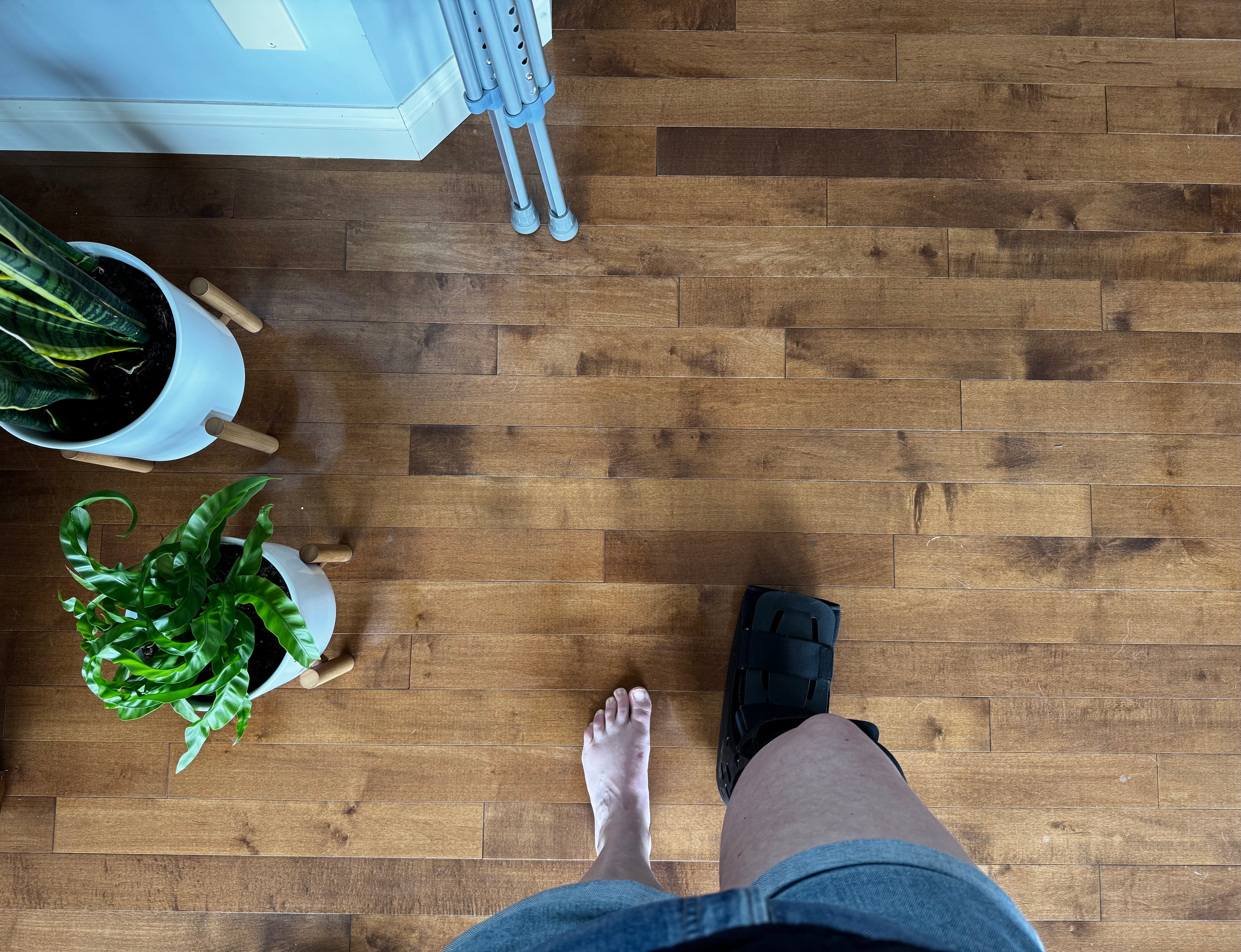
When I saw my surgeon a few weeks ago, he set the expectations. He’d review my x-rays (to be taken a few days prior to the appointment) and let me know, but it would likely look like a gradual progression to weight-bearing. Maybe 25% weight-bearing to start (and adding slowly from there).
I’d managed my expectations accordingly, assuming this meant another month or even two in the boot. I’d even come to respond to the question “how much longer will you be in the boot?” With, “forever” (through a chuckle). My system’s clever way of orienting to the hardship with the defense of humour (it’s a go-to for me).
So when I saw my surgeon this past Friday, and he informed me that upon reviewing my X-rays, I could begin “weight-bearing as tolerated,” I was thrilled.
After weeks of navigating life non-weight-bearing—first with an external fixation device, then a second surgery, then a boot, a walker, crutches, a knee scooter (aka. life-saver), and endless planning around basic tasks—I was finally being told I could start walking again.
This was the moment I’d been waiting for (cue Justin Bieber’s Everything Hallelujah).
Until it was actually time to take a step.
The moment my nervous system said “absolutely not”
Standing in the cast clinic, I cautiously lowered my foot toward the floor.
And immediately, my body recoiled.
Pins and needles shot through my foot. My nervous system flared with alarm. I instinctively pulled back and guarded the leg.
The reaction was immediate and visceral.
Fear.
Not intellectual fear.
Body fear.
The kind that responds before logic has time to catch up.
Thankfully, my surgeon was just on the other side of the curtain, having moved on from my appointment to some charting. I peeked my head around the curtain.
“Um, can I ask you a question?” (to which he responded, “of course”)
I just put my foot down, and it didn’t feel good.
Calmly, he reassured me that some discomfort was expected. That the sensations would feel strange and intense. That this was normal. He also reassured me that my body was healed enough to begin this next (literal) step.
I happily scooted my way out of the cast clinic to meet up with my friend and chauffeur for the day. As it would happen, she is someone who’s been through a major orthopedic surgery and she too was able to re-assure me. To normalize how hard this will be. She offered this perspective:
“You’ve been guarding that leg for 8 weeks, it’ll take time for your body to remember it’s ok to use… but it will.” (Thanks, Donna!)
Looking back, this experience (and what has followed), feels like such a powerful metaphor for healing work in therapy.
Sometimes we need someone reassuring us, especially in those first tentative moments of leaning toward something our nervous system still experiences as dangerous.
Someone grounded enough to help us ask:
Is this actually unsafe now?
Or is my body remembering something that once was?
The body remembers before the mind catches up
I didn’t actually try walking again until I got home. That feels important too.
There was something about being in my own environment—familiar, controlled, safe—that allowed my nervous system to soften enough to try again.
I started with my walker, the most stable mobility aid I had. The first few steps were timid. Careful. Hypervigilant.
Every sensation in my leg caught my attention.
Every pull, ache, or strange feeling made me pause and internally question:
Did I do damage?
Is something wrong?
Should I stop?
And each time, I had to gently remind myself:
sensation does not necessarily equal danger.
My surgeon had explained that pain in the 3–4 out of 10 range was expected during this phase of recovery. Some discomfort was part of the process of healing and re-loading the leg.
That distinction became incredibly important:
danger vs. discomfort
injury vs. healing sensation
protection vs. overprotection
So I started small. Three laps of the upstairs of my house. Then rest. Then a few more.
The next day I transitioned to crutches and took five laps at a time. Later that same day, I did eight.
And then, eventually, something shifted.
After a few laps with the crutches, I had gained the confidence to not use them quite as much, then I walked without using them at all (holding them “just in case”). And then…I put them down.
I was walking without aids.
Not perfectly.
Not confidently.
But naturally enough that my body had momentarily stopped bracing against every step.
That may have been the first moment I realized:
Oh… my body is starting to trust again.
The unfamiliarity of healing
There was another layer to this experience that surprised me.
By this point, I had adapted to being non-weight-bearing. I knew how to navigate my house, how to carry things while balancing on one leg, how to shower, how to move through my day protecting the injury.
It wasn’t easy.
But it had become familiar. I’d developed a “new normal” that felt manageable (albeit hard).
And suddenly, I was being asked to enter a whole new “new normal.”
What would walking feel like?
Would I trust my leg?
Would I ever move naturally again?
What if I stepped wrong?
Even though weight-bearing represented healing, it also represented uncertainty. And honestly, I think this is true in trauma work too.
Especially in complex or relational trauma healing, our protective strategies can become deeply familiar. Hypervigilance. Over-functioning. Emotional numbing. Staying small. People-pleasing. Controlling. Avoiding vulnerability.
These patterns often developed for very good reasons. And over time, they can start to feel normal—even when they are exhausting us.
So stepping into healing is not always experienced as immediate relief. Sometimes (often) it feels unfamiliar. Disorienting. Even scary.
Not because the healing is wrong, but because the entire system has adapted to an entirely different way of being.
The nervous system’s relationship with safety
This is something we understand well in trauma therapy.
Present-day experiences can activate responses connected to past danger. Trauma researchers have described this as a sense of current threat, where the nervous system reacts as though the original danger is still happening, even when the person is objectively safe (Ehlers & Clark, 2000; Lane et al., 2015).
For example, a person who has been in a car accident may feel panic the first time they get back into a vehicle or drive near the scene. Their heart races. Their muscles tense. Their breath shortens.
The bodymind remembers. Not because it is irrational or broken, but because it is trying to protect.
Note for my fellow therapy nerds: I use the term “bodymind” intentionally. There’s ongoing debate about how trauma memory is stored and processed, but clinically, what matters most is the lived experience that the body and mind are deeply interconnected in healing.
The same can happen in relational trauma.
A facial expression. Silence. Conflict. Emotional distance. Vulnerability. Disappointment.
Something in the present moment brushes up against something unresolved, and suddenly the body-mind reacts as though the original danger is happening all over again.
Again—the nervous system is not being dramatic.
It is doing its job.
Which means healing is not simply about intellectually telling ourselves:
“I’m safe now.”
(if only it were that easy)
Healing often involves slowly helping the body update its understanding of reality.
The cue that once meant danger may still activate protection—but over time, with support, processing, repetition, and new experiences, the nervous system can begin to learn:
this is now, not then.
The car is not the crash.
The vulnerability is not the original wound.
The sensation is not necessarily danger.
That’s what felt so familiar to me in those first tentative steps after injury.
My body was not wrong to protect my leg. It had learned, very recently and very vividly, that this ankle had been catastrophically injured.
But now there was new information:
the x-rays
the surgeon and my friend’s reassurance
the safety of my home
the walker beneath my hands
the gradual evidence that my leg could tolerate more
The work was not to ignore my body.
The work was to help my body update.
Healing happens in intervals
One of the biggest things this experience reminded me is that healing rarely happens all at once.
I did not immediately leap into confident walking.
I walked a few laps. Then rested. Then tried again.
The repetition mattered. The pauses mattered too. Support also mattered (deeply).
My surgeon’s reassurance mattered. The friend who drove me to the appointment and normalized my fear mattered. The stability of the walker mattered. The familiarity of home mattered.
And honestly? Self-compassion mattered.
There were moments where fear and tenderness needed to coexist.
Moments where I needed to remind myself:
Of course this feels scary.
Of course my nervous system is protective.
Of course trust takes time.
That feels deeply true in therapy too.
Trauma healing rarely happens in one dramatic breakthrough moment. More often, it happens through small, repeated experiences of “safe enough.”
A little vulnerability… met with care and compassion.
A little overwhelm… navigated with support and regulation.
A little more honesty, trust, or emotion… with just enough safety for the nervous system to stay present.
Over and over again, the bodymind slowly gathers new evidence:
Maybe I don’t have to navigate this alone anymore.
Maybe I am safe enough.
Maybe I can cope.
What I hope you hear in this
If you are actively working through trauma—especially relational or complex trauma—I hope you hear this clearly:
It is okay if healing feels scary.
It is okay if part of you wants to move forward while another part braces against the unknown. It is okay to need support. It is okay to move slowly. And it is okay if your system needs repetition, reassurance, pacing, and rest in order to trust what your conscious mind already knows (that the trauma is in the past, not here in the present).
And none of those fears or needs mean you are doing healing wrong. It means you are human.
A few gentle questions to sit with
Where in your life might your nervous system still be responding to an old danger?
What protective strategies once kept you safe—but may no longer fit the season you’re in?
What helps you feel “safe enough” to take the next (literal or metaphorical) step?
What supports, pacing, or reassurance might your healing process need right now?
What would it look like to trust yourself slowly, rather than all at once?
Still learning
Walking is becoming easier now. This morning before I wrote this I was even able to do some light cleaning around the house. And yes I did get curious about whether productivity was driving or whether I genuinely wanted to do some chores (I’d say it was mostly the latter… which feels like growth).
But the take-home? There were moments this morning where I moved fairly naturally. Naturally enough that I briefly forgot to be afraid. And honestly, that feels like a profound metaphor for healing itself.
Not the absence of fear. Not the complete disappearance of protective instincts. But the gradual emergence of trust.
Trust in the body. Trust in support. Trust that healing can happen slowly.
One supported step at a time.
Onward in thriving,
Gillian
References
Ehlers, A., & Clark, D. M. (2000). A cognitive model of posttraumatic stress disorder. Behaviour Research and Therapy, 38(4), 319–345. https://doi.org/10.1016/S0005-7967(99)00123-0
Lane, R. D., Ryan, L., Nadel, L., & Greenberg, L. (2015). Memory reconsolidation, emotional arousal, and the process of change in psychotherapy: New insights from brain science. Behavioral and Brain Sciences, 38, E1. https://doi.org/10.1017/S0140525X14000041